-
Whatsapp: +86 13526572721
-
Email: info@zydiamondtools.com
-
Address: AUX Industrial Park, Zhengzhou City, Henan Province, China
-
Whatsapp: +86 13526572721
-
Email: info@zydiamondtools.com
-
Address: AUX Industrial Park, Zhengzhou City, Henan Province, China

How to Choose the Correct Coolant Strategy (High-Pressure vs. Flood vs. MQL) for PCBN Turning?
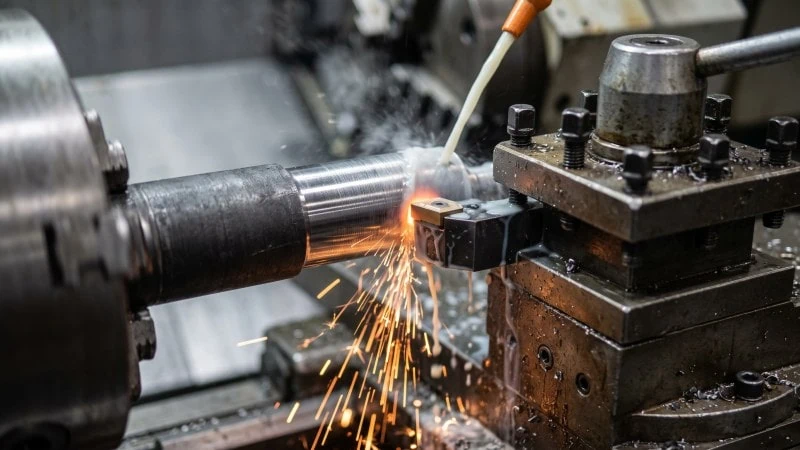
What is the most effective way to select the right coolant strategy when hard turning with PCBN inserts?
Choosing the correct coolant strategy for PCBN turning requires matching the thermal and mechanical demands of the operation to the fluid delivery method. High-Pressure Coolant (HPC) is optimal for continuous roughing to break chips and penetrate vapor barriers, whereas Minimum Quantity Lubrication (MQL) or dry cutting is mandatory for precision finishing and interrupted cuts to prevent insert fracture from thermal shock. Traditional flood coolant should be reserved exclusively for maintaining bulk dimensional stability on massive, heat-sensitive components.
The Unique Demands of PCBN in Hard Turning Applications
What exactly makes Polycrystalline Cubic Boron Nitride (PCBN) so demanding during hard turning1 operations?
PCBN tooling demands highly controlled environments because it excels at cutting hardened materials (typically 45-70 HRC) but remains extremely vulnerable to rapid temperature fluctuations. Specifically, the material’s high hot hardness generates immense heat at the cutting edge, requiring precise thermal management to prevent catastrophic tool failure from thermal shock.
Managing Extreme Cutting Zone Temperatures
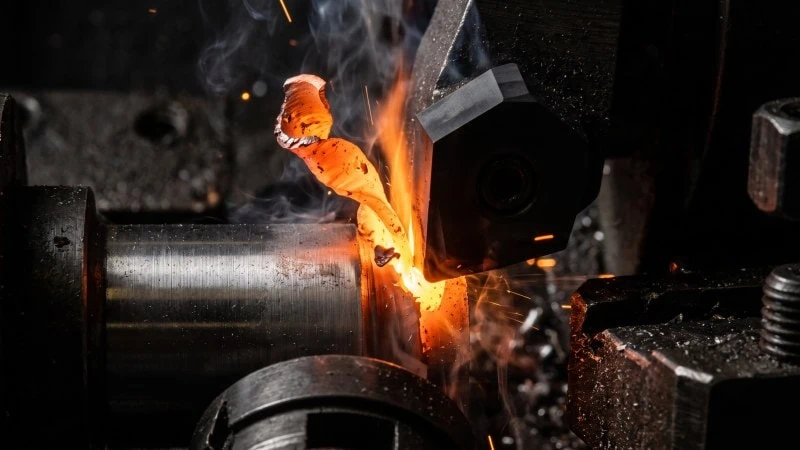
When turning hardened steel, friction creates massive amounts of heat. In fact, temperatures at the tool-chip interface can easily exceed 1,000°C (1,832°F). However, this heat is not entirely bad. PCBN relies on this intense temperature to slightly soften, or plasticize, the metal just ahead of the cutting edge. Therefore, the cutting process actually becomes smoother.
This localized softening is conceptually similar to the principles behind friction welding2, where controlled, intense heat plasticizes the tough metal, allowing it to yield smoothly rather than tearing. The localized heat makes the tough material much easier to shear away.
Consequently, you must manage this heat rather than eliminate it entirely. If the cutting zone gets too cold, the metal hardens. As a result, the cutting forces spike, and the tool edge chips. On the other hand, if the heat builds up too much, the ceramic binder holding the CBN particles together will begin to break down.
To strike the right balance, you need to understand the physical makeup of your specific insert. Low-CBN inserts handle high temperatures differently than high-CBN inserts.
| PCBN Insert Type | Typical CBN Content | Heat Tolerance | Primary Application |
|---|---|---|---|
| Low-CBN Content | 45% – 65% | Very High | Continuous finishing of hardened steels |
| High-CBN Content | 80% – 95% | Moderate | Heavy roughing or cast iron machining |
Because binder compositions vary wildly, always verify the exact temperature limits and ideal operating ranges directly with your specific tooling supplier.
Ultimately, your primary goal is to maintain a stable, predictable temperature. Frequent temperature fluctuations destroy PCBN tools much faster than steady, extreme heat.
Preventing Insert Fractures Caused by Thermal Shock
Are your PCBN inserts suddenly breaking instead of wearing down normally? This sudden failure usually points directly to thermal shock3.
Thermal shock happens when a material expands and contracts too rapidly. PCBN is incredibly hard, but it is also exceptionally brittle. Therefore, when the tool edge heats up in the cut and suddenly cools down out of the cut, the material structure stresses. Consequently, microscopic cracks begin to form along the cutting edge.
Consider what happens if you take a glowing-hot solid carbide drill bit and immediately dunk it into a bucket of cold coolant. The bit will instantly crack or shatter. PCBN inserts react the exact same way to aggressive temperature swings.
This thermal cracking typically progresses in three distinct stages:
- Surface Crazing: Tiny, hair-like cracks appear on the rake face of the insert.
- Crack Propagation: These small cracks connect and grow deeper into the ceramic substrate.
- Catastrophic Edge Failure: A large chunk of the cutting edge breaks off completely, ruining the workpiece.
“Consistency in the thermal environment is the single most critical factor for extending PCBN insert life during hard turning.”
To prevent these fractures, the cutting environment must remain thermally stable. For instance, if the tool exits the cut and ambient air cools it, a sudden blast of cold fluid upon re-entry will cause immediate shock. Thus, managing exactly how and when you remove heat from the tooling setup dictates your operational success.
When to Apply High-Pressure Coolant (HPC)
When exactly should you implement a High-Pressure Coolant (HPC) system for your PCBN turning operations?
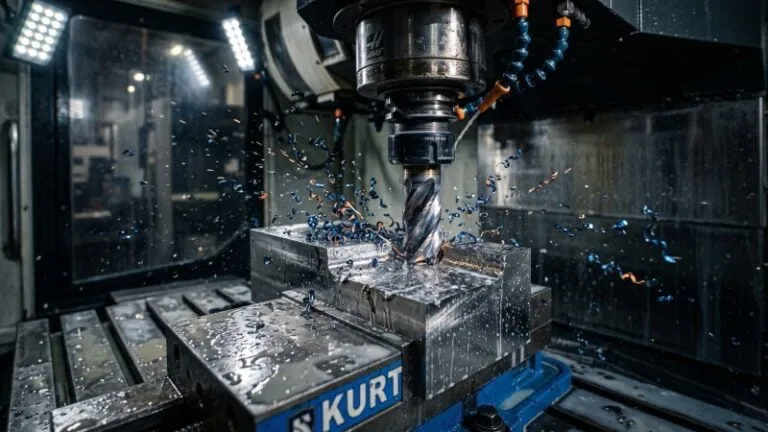
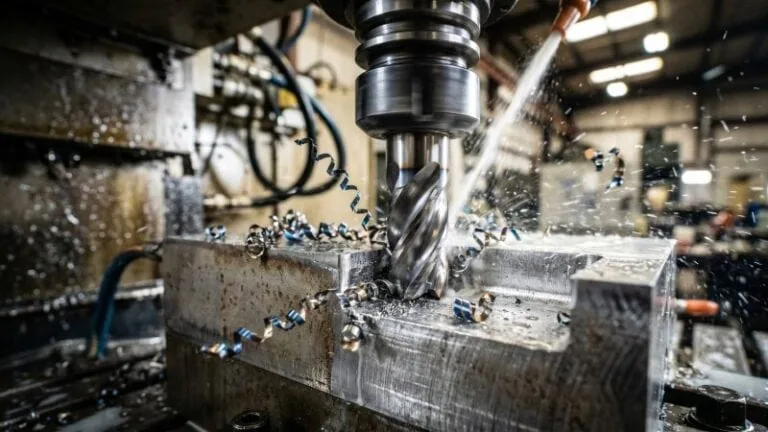
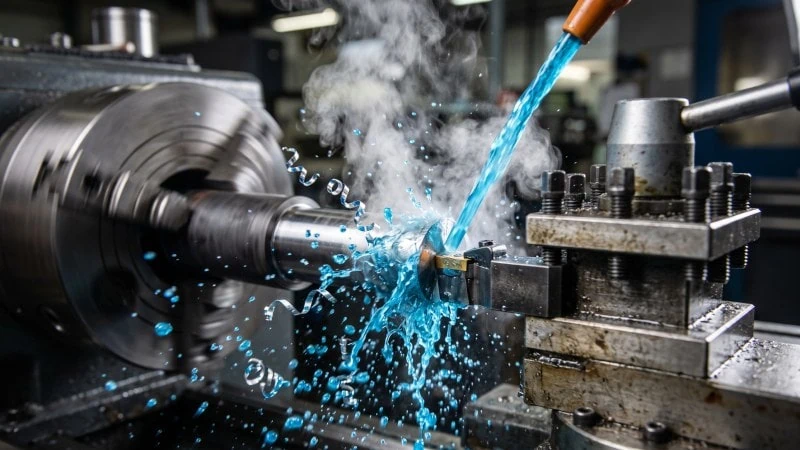
You should apply High-Pressure Coolant (HPC) during continuous turning operations where stringy chips threaten surface finish and automated production. High-Pressure systems, typically operating between 70 bar and 300 bar, excel by directing a high-velocity jet precisely at the cutting zone. Consequently, this intense pressure wedges between the chip and the rake face, effectively snapping the chips. Furthermore, this intense velocity breaks the thermal vapor barrier to deliver immediate, necessary cooling directly to the PCBN insert.
Maximizing Chip Breakage in Continuous Operations
Continuous turning of hardened steel often produces a major manufacturing hazard. Specifically, it creates long, unbroken chips. Consequently, these stringy chips tangle tightly around the chuck or the workpiece. As a result, they can severely scratch the finished surface. Furthermore, this bird-nesting effect completely halts automated robotic cells. Therefore, HPC provides a highly reliable mechanical solution to this problem.
Initially, the high-velocity fluid acts exactly like a physical hydraulic wedge. Thus, it forcefully lifts the hot chip directly off the insert’s rake face. Next, the sheer kinetic force of the liquid bends the chip past its breaking point. Consequently, the metal snaps into small, manageable shapes, typically resembling the numbers six or nine.
Think about deep hole gun drilling, where high-pressure fluid is absolutely required to force heavy, continuous chips out of a deep cavity before they pack and snap the tool. Similarly, the HPC fluid on a lathe uses raw kinetic energy to force the continuous turning chip to yield. To achieve this, coolant pressures typically must exceed 70 bar (1,000 psi). Ultimately, mastering this applied pressure ensures smooth, uninterrupted production runs.
Penetrating the Vapor Barrier for Direct Edge Cooling
What happens when standard coolant hits a cutting zone exceeding 1,000°C? Predictably, the liquid instantly boils upon initial contact. As a result, a protective blanket of steam immediately forms over the cutting tool. Industry experts commonly call this physical phenomenon the vapor barrier.
Consequently, standard low-pressure coolant simply bounces off this invisible barrier. Therefore, the cooling fluid never actually touches the hot ceramic edge. Thus, the tool overheats rapidly and fails. However, HPC overcomes this stubborn physics problem effortlessly.
Specifically, the extreme velocity of the jet easily pierces through the steam pocket. As a result, the cold fluid makes direct, continuous contact with the cutting edge. You can directly compare this to an EDM (Electrical Discharge Machining) flushing nozzle. During EDM processing, high-pressure dielectric fluid must forcefully clear microscopic debris and gas bubbles out of a deep cavity to prevent arcing. Similarly, HPC clears the steam barrier to prevent sudden thermal damage. Therefore, the PCBN tool maintains a stable, highly controlled operating temperature.
Balancing Pressure Limits to Avoid Premature Tool Wear
Can too much fluid pressure actually destroy a hardened PCBN insert? Yes, it absolutely can. PCBN is incredibly hard, yet it remains exceptionally brittle. Therefore, excessive hydraulic force acts just like a microscopic hammer.
Consequently, this relentless pressure constantly batters the fragile cutting edge. As a result, you will quickly observe premature edge chipping4. Furthermore, extreme pressure can cause the insert to shift slightly inside the tool holder. Thus, you must carefully find the optimal pressure zone for your specific turning application.
Typically, shop managers find the ultimate sweet spot between 70 bar and 120 bar for standard hard turning. However, pressures approaching 300 bar (4,350 psi) are often far too aggressive for standard PCBN grades.
| Pressure Level | Typical Result on PCBN | Recommended Application |
|---|---|---|
| Low (< 20 bar) | Fails to break chips or pierce steam. | General machining, not ideal for PCBN. |
| Optimal (70 – 120 bar) | Excellent chip control and stable edge life. | Continuous hard turning operations. |
| Excessive (> 200 bar) | Causes micro-chipping and edge fracture. | Only for specific, reinforced tooling setups. |
Therefore, more pressure does not always equal better cutting performance. Instead, you must carefully balance the hydraulic force against the mechanical strength of the ceramic insert. Ultimately, careful pressure management drastically extends your tooling lifespan while maintaining part quality.
The Role of Traditional Flood Coolant
Is traditional flood coolant still a viable option when turning hardened materials with PCBN tools?
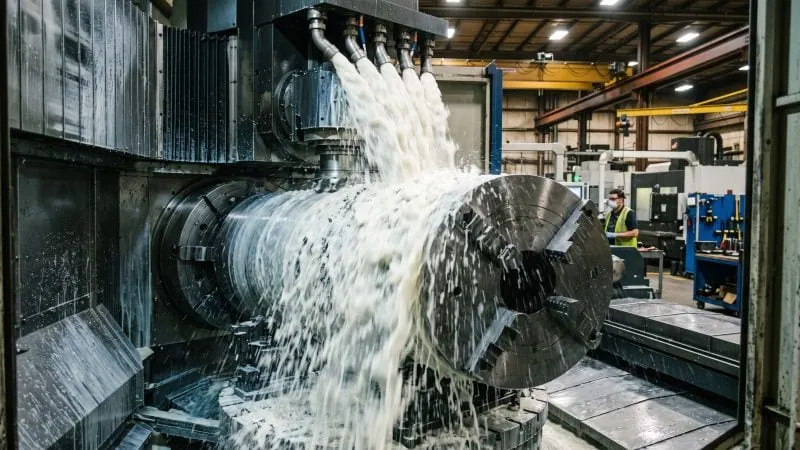
Traditional flood coolant remains a practical choice primarily for maintaining the overall dimensional stability of large workpieces during long machining cycles. It utilizes large volumes of low-pressure fluid, typically between 10 to 30 gallons per minute, to soak the entire machining area. Consequently, this continuous soaking prevents the bulk material from absorbing excess heat, which ensures tight tolerances are met on massive or thin-walled components.
Maintaining Bulk Part Temperature Stability
When machining massive components, heat transfer becomes a major manufacturing issue. Specifically, the intense friction from PCBN hard turning generates massive thermal energy. A large portion of this heat transfers directly into the workpiece. Consequently, the metal part begins to expand thermally.
Are you struggling to hold tight dimensional tolerances on long cutting passes? If so, bulk part expansion is likely the primary culprit. Therefore, traditional flood coolant serves as a highly effective thermal regulator. By delivering a massive, continuous volume of fluid, it completely submerges the metal part. Thus, the cutting fluid acts exactly like a giant heat sink.
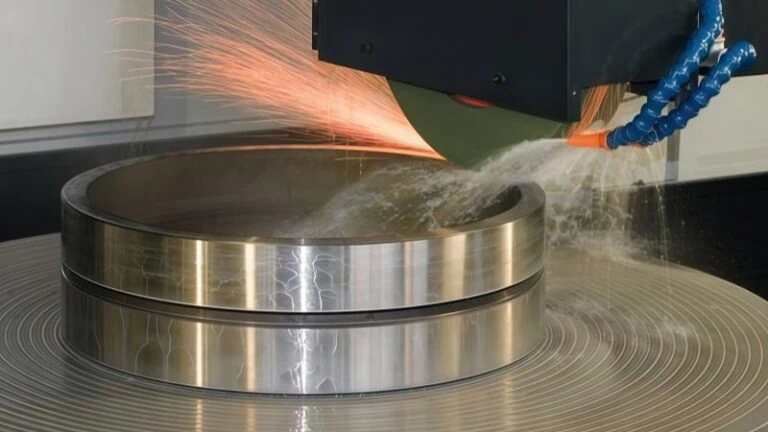
Consider a similar workshop process, such as surface grinding a large steel mold base. In surface grinding, heavy flood coolant is absolutely required to prevent the steel plate from warping under the heat. Similarly, flood coolant in PCBN turning prevents thin-walled aerospace bearing rings from distorting. For example, maintaining a strict 0.0002-inch tolerance on a large bearing ring is nearly impossible if the part heats up. Thus, the heavy fluid volume keeps the core part temperature incredibly stable throughout the entire cycle.
Limitations of Low-Pressure Delivery in High-Speed Cutting
Despite its excellent bulk cooling ability, traditional flood coolant has severe performance limitations. Specifically, it fails dramatically right at the tool’s cutting edge during high-speed turning. Why does this cooling failure happen? The answer lies entirely in the low delivery pressure.
Standard flood systems operate at very low pressures. Typically, these machine systems push fluid at roughly 1 to 3 bar (15 to 45 psi). Consequently, this low hydraulic pressure simply cannot penetrate the intense cutting zone.
Furthermore, as spindle speeds increase, the rapidly spinning chuck and workpiece create a strong centrifugal wind barrier. Therefore, they literally blow the low-pressure coolant away before it ever touches the cutting tool.
Think about trying to clean packed metal chips out of a deep tapped hole. A low-pressure wash hose will simply overflow at the top of the hole. Instead, you need a highly focused air blast to reach the bottom. Similarly, flood coolant just splashes uselessly over the top of the hot PCBN insert. It never actually reaches the actual friction point.
As a result, the tool edge overheats rapidly. Then, the flood fluid sporadically splashes onto the superheated ceramic insert. Consequently, this inconsistent splashing causes immediate and catastrophic thermal shock.
| Performance Feature | Traditional Flood Coolant | High-Pressure Coolant (HPC) |
|---|---|---|
| Typical Delivery Pressure | 1 – 3 bar (15 – 45 psi) | 70 – 120 bar (1,000+ psi) |
| Fluid Delivery Volume | Very High (Drenching) | Moderate to Low (Targeted) |
| Tool Edge Penetration | Poor (Deflected by spinning parts) | Excellent (Pierces vapor barrier) |
| Primary Process Benefit | Prevents workpiece thermal expansion | Breaks chips and cools the insert edge |
Ultimately, while flood delivery saves the workpiece from heat distortion, it often actively harms the PCBN tool life during high-speed engagements.
Why Minimum Quantity Lubrication (MQL) Excels in PCBN Finishing
Why is Minimum Quantity Lubrication (MQL) often considered the absolute best strategy for precision finishing passes with PCBN tools?
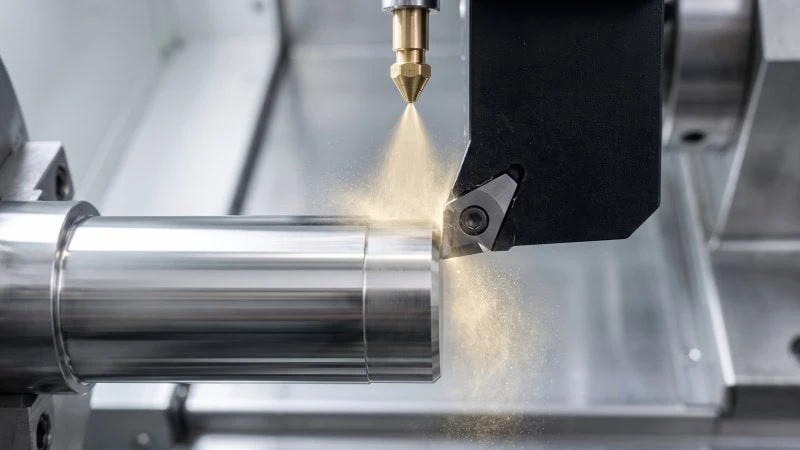
Minimum Quantity Lubrication (MQL) excels in PCBN finishing by delivering a highly targeted, microscopic aerosol of oil directly to the cutting zone. This method provides extreme lubricity without causing aggressive temperature swings. Consequently, this near-dry process minimizes friction, entirely prevents thermal shock to the brittle ceramic insert, and consistently achieves superior surface finishes while consuming barely any fluid.
Achieving Near-Dry Cutting to Prevent Thermal Fluctuations
MQL fundamentally changes how you manage heat during a turning operation. Standard fluids attempt to pull heat away from the workpiece. Conversely, MQL focuses purely on reducing the friction that causes the heat in the first place.
During a finishing pass, the depth of cut is very shallow. Therefore, the overall heat generation is lower than in heavy roughing. However, the PCBN insert still requires a stable, warm temperature to perform correctly. If you drench this shallow cut with liquid coolant, the insert cools down far too quickly. As a result, catastrophic thermal shock occurs.
MQL solves this by using compressed air to deliver microscopic oil droplets. This creates a “near-dry” environment. The air blast clears away microscopic metal dust. Meanwhile, the tiny oil droplets lubricate the cutting edge. Thus, the tool and the workpiece heat up gradually and remain at a steady, predictable temperature.
Think about using an air blast to clear chips during a dry milling operation on a machining center. The air keeps the cutter clear but does not shock the carbide. MQL applies this same gentle, stable principle, but adds a critical micro-layer of lubrication.
Because optimal droplet size and air pressure depend heavily on your specific nozzle design and air supply, always verify the exact system settings with your MQL equipment supplier.
Improving Surface Finish Quality Through High-Lubricity Aerosols
Does your turning process struggle to meet strict surface roughness (Ra)5 requirements? If so, poor lubrication at the cutting edge is often the cause.
During high-speed finishing, intense friction can cause microscopic tearing on the machined surface. Furthermore, tiny particles of the workpiece can weld themselves to the PCBN insert. This issue is known as Built-Up Edge (BUE)6. Once BUE forms, the welded metal drastically degrades the surface finish of your part.
MQL directly combats this surface degradation. The high-lubricity oil aerosol coats the exact point of contact. Consequently, the PCBN insert glides smoothly against the hardened steel. This drastically reduces the friction coefficient. Therefore, the metal shears away cleanly without tearing or galling.
Consider a common workshop task like tapping a deep thread in a sticky material like aluminum. A single drop of high-quality, high-viscosity tapping fluid prevents the metal from galling. Consequently, it leaves a perfectly smooth, clean thread. MQL applies this exact same principle of high-performance lubrication, but it does so continuously at a microscopic level.
“By eliminating friction-induced tearing, MQL allows PCBN inserts to consistently achieve grinding-quality surface finishes directly on the lathe.”
Economic and Environmental Benefits of Micro-Dosing
Beyond technical performance, MQL drastically transforms shop floor economics. Traditional cooling methods require massive fluid volumes. Conversely, MQL operates on a principle of precise micro-dosing.
Specifically, a typical MQL system consumes only 10 to 50 milliliters of oil per hour. This is practically nothing compared to the gallons per minute pumped by traditional systems. As a result, you immediately eliminate the massive costs associated with buying, mixing, and testing drums of coolant.
Furthermore, MQL creates a vastly superior environmental footprint. Traditional wet chips are coated in sticky, messy oil. Therefore, they require expensive centrifugal spinning before metal recyclers will accept them. In contrast, MQL chips exit the machine completely dry. Thus, they are ready for immediate, high-value recycling.
| Operational Cost Factor | Traditional Wet Systems | MQL Systems |
|---|---|---|
| Fluid Consumption | Very High (Gallons per minute) | Extremely Low (Milliliters per hour) |
| Coolant Disposal Costs | High (Requires hazardous waste processing) | Zero (Fluid is consumed in the cut) |
| Chip Condition | Wet and contaminated | Dry and ready for recycling |
| Machine Maintenance | High (Sump cleaning, tramp oil removal) | Low (No sump maintenance required) |
Additionally, MQL eliminates rancid coolant smells and slippery shop floors. Ultimately, upgrading to MQL for PCBN finishing not only improves your tool life, but it also creates a cleaner, safer, and highly profitable manufacturing environment.
Operation-Based Selection Framework
To select the correct coolant strategy, you must analyze three core variables: the continuity of the cut, the depth of the machining pass, and the exact metallurgical properties of the workpiece. Continuous roughing in steel demands High-Pressure Coolant (HPC) for chip control, interrupted cuts require dry machining or MQL to prevent thermal shock, and highly abrasive materials like cast iron often necessitate dry cutting or specialized air blasts.
Continuous vs. Interrupted Cutting Profiles
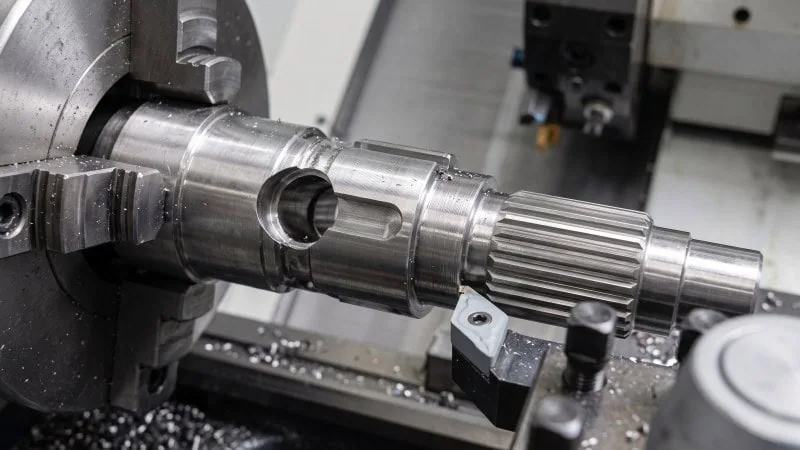
Does your workpiece have a perfectly smooth diameter, or does it feature cross-holes, keyways, and splines? This structural geometry dictates your entire cooling approach.
During a continuous cut on a smooth cylinder, the PCBN insert stays buried in the metal. Consequently, the cutting zone temperature rises and stabilizes. Because the heat remains steady, you can safely introduce High-Pressure Coolant (HPC). The continuous fluid flow manages the stable heat without shocking the ceramic.
Conversely, an interrupted cut drastically changes the thermal dynamics. When the turning tool passes over a cross-hole, it temporarily exits the metal. During this split second, the tool cools down. Then, it aggressively slams back into the hardened steel, spiking the heat instantly.
If you apply traditional liquid coolant during an interrupted cut, the fluid blasts the tool exactly when it exits the cut. This creates an extreme, artificial temperature drop. As a result, the tool suffers immediate thermal shock and shatters.
Think about face milling a block of steel with a carbide cutter. As the milling inserts spin in and out of the material, they experience rapid thermal cycling. Machinists run these milling operations dry to prevent the inserts from cracking. You must apply this exact same logic to interrupted PCBN turning.
Therefore, for severe interrupted cuts, you should turn off the liquid coolant completely. Instead, utilize dry machining or switch to a very fine MQL aerosol to provide gentle lubrication without aggressive chilling.
Heavy Roughing vs. Precision Finishing Passes
The volume of metal you remove directly influences the required cooling power. Heavy roughing and precision finishing represent two completely different machining environments.
In heavy roughing, the primary goal is rapid metal removal. You are taking a deep depth of cut, often exceeding 0.5mm (0.020 inches) in hardened materials. This deep engagement generates massive, thick chips and extreme heat. Here, HPC is mandatory. The high-velocity liquid manages the intense heat, prevents plastic deformation of the insert, and forcefully breaks the thick chips before they tangle.
Finishing passes, however, barely skim the surface. The depth of cut is extremely shallow. Therefore, the overall heat generation is much lower. If you hit a delicate finishing insert with high-pressure fluid, you will over-cool the cutting zone. The material will remain too hard, and the surface finish will suffer.
| Operation Type | Primary Objective | Thermal Generation | Optimal Strategy |
|---|---|---|---|
| Heavy Roughing | Maximize metal removal rate | Extreme (Requires active removal) | High-Pressure Coolant (HPC) |
| Precision Finishing | Achieve superior surface finish | Moderate (Requires stabilization) | MQL or Dry Cutting |
For finishing, you simply need to reduce friction. Consequently, MQL becomes the superior choice. It provides the necessary lubricity to shear the metal cleanly, ensuring a mirror-like finish without altering the delicate thermal balance.
Material Specifics: Hardened Steel vs. Pearlitic Cast Iron
Not all hard materials react to coolant in the same way. In fact, applying the wrong fluid to certain metals will actively destroy your CNC machine.
When you turn hardened steel alloys, like 52100 bearing steel, the material forms long, continuous ribbons. These steel strings require a physical force to break them. Therefore, high-pressure liquid strategies work perfectly.
Pearlitic cast iron behaves completely differently. Cast iron is highly abrasive and brittle. When you turn it, it does not form strings. Instead, it crumbles into fine, powdery chips.
If you apply flood coolant or HPC to cast iron, the liquid mixes with the fine metal powder. Consequently, this mixture creates a highly abrasive, destructive sludge. This sludge acts exactly like a heavy lapping paste. It will rapidly wear out your machine’s slideways, destroy your coolant pumps, and clog your filtration systems.
“Applying liquid coolant to cast iron machining creates an abrasive slurry that degrades machine tool components faster than the actual cutting process wears the insert.”
Because of this specific metallurgical property, you must avoid liquid coolants entirely when turning cast iron7. Instead, you should rely on strictly dry machining. If you need to clear the abrasive dust from the cutting zone, utilize a strong, targeted blast of compressed air.
Equipment Setup and Tool Integration
Successfully integrating high-pressure or MQL systems requires specialized through-tool delivery mechanisms and upgraded machine infrastructure. You must utilize precisely targeted tool holders to route fluids directly to the insert edge, while simultaneously upgrading to high-pressure pumps and fine-micron filtration systems to prevent catastrophic equipment failures.
Optimizing Through-Tool Delivery Mechanisms
Are you still using adjustable copper lines to aim your coolant? If so, you are wasting the potential of your expensive PCBN inserts. External coolant lines easily vibrate out of position during heavy machining. Consequently, the fluid completely misses the tiny cutting edge.
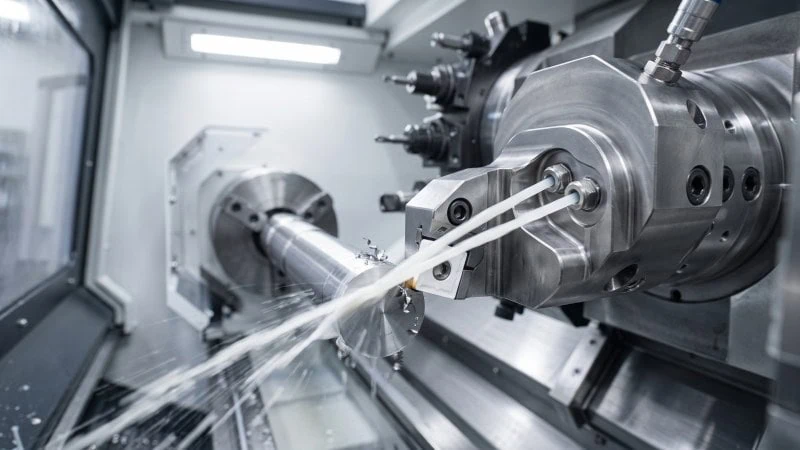
To maximize performance, you must use dedicated through-tool delivery systems. These specialized tool holders feature internal plumbing. They route the liquid or MQL aerosol directly through the solid steel shank. Then, the fluid exits through precisely machined nozzles located just millimeters from the ceramic insert.
Think about through-spindle coolant (TSC) on a vertical machining center used for deep-hole drilling. The fluid must travel directly through the tool body to the very tip to be effective. Similarly, through-tool turning holders require exact internal routing to hit the precise friction point.
These advanced tool holders typically feature two distinct delivery paths:
- Over-head delivery: Aims directly at the rake face to break chips and cool the insert top.
- Under-coolant delivery: Aims at the flank face to reduce friction against the workpiece shoulder.
By utilizing these internal passages, the coolant jet never moves. Therefore, you guarantee 100% accurate delivery on every single part cycle. Furthermore, this internal routing eliminates bulky external hoses that often interfere with complex turret indexes.
Filtration and Pump Requirements for Advanced Systems
Upgrading to an advanced coolant strategy involves much more than simply changing the tool holder. You must also fundamentally upgrade the plumbing inside your CNC machine. Standard centrifugal pumps simply cannot generate the necessary force for high-pressure delivery.
Therefore, you must install a positive displacement pump8. These high-performance pumps easily generate pressures exceeding 70 bar (1,000 psi). However, because pump capacities and motor requirements vary heavily based on the specific machine tool builder, always verify exact power requirements directly with your equipment supplier.
Furthermore, generating high pressure introduces a massive new risk: fluid contamination. When you push coolant at 1,000 psi, any suspended metal chips become deadly projectiles. If dirty coolant enters a high-pressure pump, the tiny metal shavings will instantly destroy the internal seals.
Consider the precision spindle bearings in a high-speed machining center. If microscopic grit enters those bearings, they will score and fail immediately. High-pressure coolant pumps react exactly the same way to unfiltered metal dust.
To prevent this destruction, you must install specialized fine filtration systems alongside your new pumps.
| System Component | Traditional Flood | High-Pressure Coolant (HPC) |
|---|---|---|
| Pump Type | Standard Centrifugal | Positive Displacement |
| Required Filtration | 50 to 100 microns | 5 to 10 microns |
| Maintenance Focus | Monitoring sump volumes | Frequent filter element replacement |
“Inadequate filtration will destroy a high-pressure coolant pump in less than 48 hours of continuous operation.”
Ultimately, you must filter the fluid down to at least 10 microns before it reaches the pump inlet. By pairing robust pumps with ultra-fine filtration, your coolant delivery system will remain reliable, powerful, and highly efficient.
Conclusion
Ultimately, optimizing your PCBN hard turning operations boils down to precisely controlling the heat and friction at the cutting edge. By carefully evaluating whether your specific machining process demands the aggressive chip-breaking power of High-Pressure Coolant (HPC), the thermal stabilization of standard flood coolant, or the delicate micro-lubrication of Minimum Quantity Lubrication (MQL), you can drastically extend your tool life and guarantee superior part quality. Always ensure your CNC equipment is properly outfitted with the correct high-pressure pumps, fine filtration systems, and through-tool delivery mechanisms to fully support and maintain your chosen coolant strategy.
References
- Hard Turning1 – ZYDiamondTools guide explaining hard turning principles and how the process compares to grinding.
- Friction Welding2 – Wikipedia article explaining the principles of plasticizing metal using mechanical friction and heat.
- Thermal Shock3 – Wikipedia overview detailing why rapid temperature fluctuations cause structural stress and fracturing in brittle materials.
- Premature Edge Chipping4 – ZYDiamondTools machinist’s guide to diagnosing and solving rapid tool wear and edge failure.
- Surface Roughness (Ra)5 – Wikipedia page detailing the parameters and measurements for evaluating surface finish quality.
- Built-Up Edge (BUE)6 – ZYDiamondTools article covering the causes of material welding on inserts and preventative techniques.
- Turning Cast Iron7 – ZYDiamondTools comprehensive guide to the specific challenges and techniques for machining highly abrasive hard cast iron.
- Positive Displacement Pump8 – Wikipedia section on the mechanics of positive displacement pumps required to generate high fluid pressures.