-
Whatsapp: +86 13526572721
-
Email: info@zydiamondtools.com
-
Address: AUX Industrial Park, Zhengzhou City, Henan Province, China
-
Whatsapp: +86 13526572721
-
Email: info@zydiamondtools.com
-
Address: AUX Industrial Park, Zhengzhou City, Henan Province, China

The Ultimate Guide to Choosing Diamond and CBN Wheels for Centerless Grinding
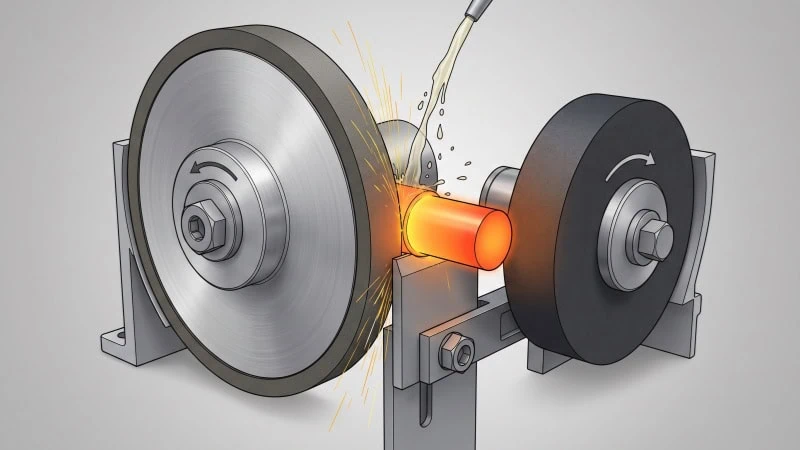
What are the critical factors for selecting the perfect Diamond or CBN wheel for centerless grinding applications?
Selecting the ideal superabrasive wheel for centerless grinding requires matching the abrasive material to the workpiece, choosing the correct bond type based on your specific feed method, and optimizing the wheel core and regulating wheel pairing to ensure continuous dimensional stability and eliminate vibration.
How Centerless Mechanics Dictate Superabrasive Wheel Design
Why can’t you use standard superabrasive wheels designed for conventional cylindrical grinders in a centerless operation?
Centerless grinding relies on continuous dynamic pressure between the grinding wheel, regulating wheel, and work rest blade. Consequently, Diamond and CBN wheels for these systems must be engineered with superior structural rigidity and exceptionally low wear rates to maintain exact part geometry without the fixed center support used in traditional setups.
The Impact of Wheel Wear on Thru-Feed Dimensional Accuracy
In thru-feed centerless grinding, parts travel continuously across the entire face of the grinding wheel. Therefore, the physical distance between the grinding wheel and the regulating wheel strictly dictates the final size of your workpiece.
Why does a tiny change in wheel diameter matter so much? If the abrasive layer wears down quickly, the grinding gap slowly widens. As a result, parts processed later in the batch will be oversized and out of tolerance. This direct relationship makes dimensional stability a primary focus when selecting superabrasives.
Diamond and CBN wheels offer an exceptionally high G-ratio compared to conventional abrasives. The G-ratio specifically measures the volume of material removed versus the volume of wheel wear. For instance, when grinding 52100 bearing steel, a standard aluminum oxide wheel might require a size adjustment after only 50 parts. In contrast, a well-matched CBN wheel can often grind thousands of parts before any machine compensation is necessary.
Consider a machining analogy. Using a high-wear wheel in a thru-feed process is like milling a flat surface with an end mill that shrinks during the cut. You would constantly chase the final dimension. Superabrasives eliminate this constant chasing. Ultimately, they ensure straight, accurate parts from the very first piece to the last.
Continuous Production Demands Versus Conventional Grinding
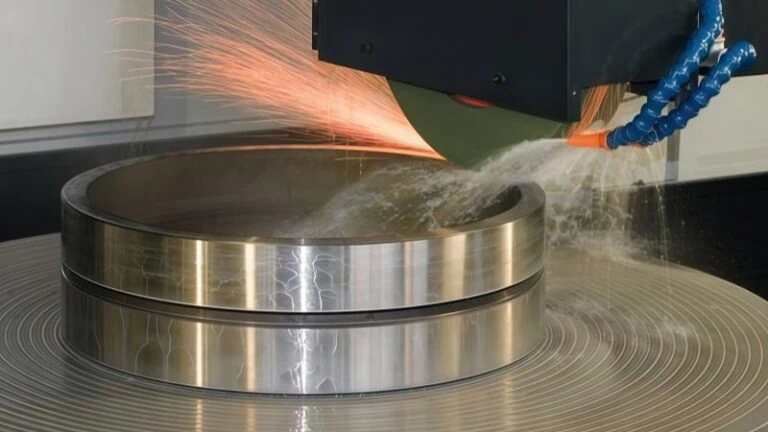
Centerless grinding machines are fundamentally built for non-stop, high-volume production. This unique operating style places very different demands on a grinding wheel compared to conventional methods.
Traditional cylindrical grinding holds a single part rigidly between two centers. This process naturally includes frequent pauses to load and unload each individual part. During these brief pauses, both the grinding wheel and the machine components have a chance to cool down.
However, centerless thru-feed grinding never pauses. Parts feed back-to-back directly into the machine. Consequently, the grinding wheel remains under constant thermal and mechanical stress. The Diamond or CBN wheel must therefore be designed to handle this continuous, unbroken grinding action without failing or losing its profile.
Centerless vs. Conventional Grinding Mechanics
| Process Feature | Centerless Thru-Feed | Conventional Cylindrical |
|---|---|---|
| Part Support | Dynamic (Blade & Regulating Wheel) | Fixed (Between Centers) |
| Thermal Cycle | Continuous heat generation | Intermittent cooling during loading |
| Wheel Stress | Constant, sustained pressure | Variable, cyclic pressure |
| Production Volume | Extremely High | Low to Medium |
Because of this continuous cycle, heat management becomes extremely critical. If a wheel retains too much heat, thermal expansion1 occurs. The wheel actually grows slightly in size. This expansion shrinks the grinding gap and immediately results in undersized parts. Therefore, when choosing a superabrasive wheel for centerless applications, you must ensure its overall design is optimized to handle continuous pressure and dissipate sustained heat effectively.
Matching Bond Types to Specific Centerless Feed Methods
Which abrasive bond type is best suited for your specific centerless feed method and material?
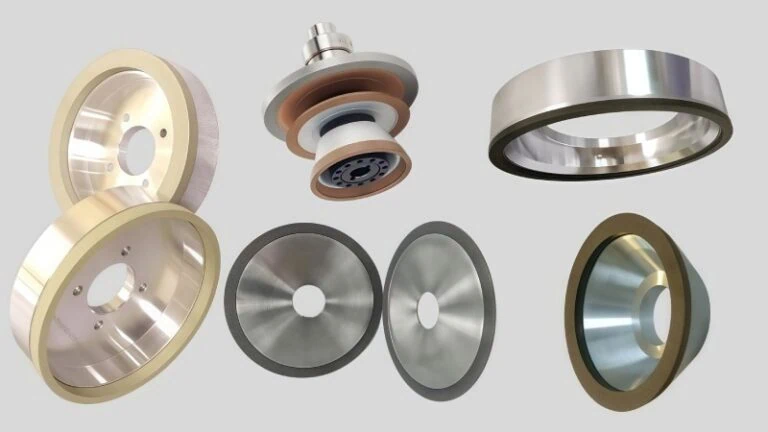
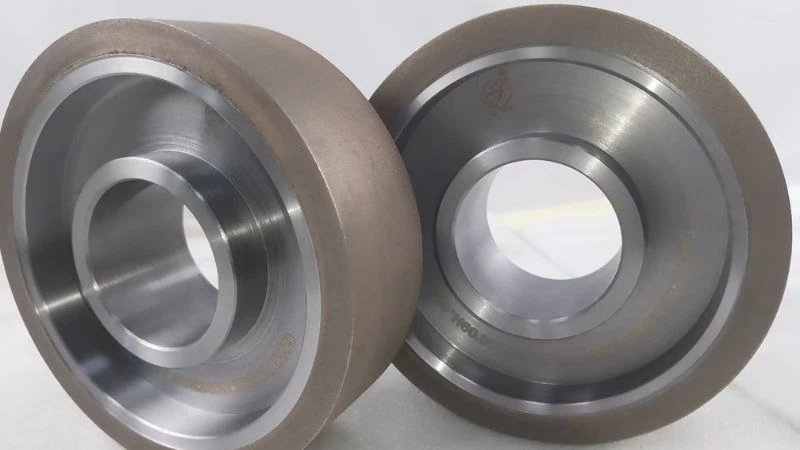
Selecting the correct bond type depends directly on your specific centerless grinding method—thru-feed or in-feed—and the workpiece material. Vitrified bonds provide high porosity for continuous thru-feed cooling, resin bonds offer a forgiving cut for brittle plunge applications, and metal bonds deliver maximum shape retention for grinding complex profiles.
Centerless Bond Selection Guide
| Bond Type | Ideal Feed Method | Target Material Focus | Key Production Benefit |
|---|---|---|---|
| Vitrified CBN | Thru-Feed | Ferrous (Hardened Steels) | Superior coolant delivery |
| Resin Diamond | In-Feed (Plunge) | Non-Ferrous (Carbides) | Chip-free surface finish |
| Metal Bond | In-Feed (Profile) | Mixed Hard Materials | Excellent edge retention |
Vitrified CBN for High-Volume Thru-Feed Steel Components
Thru-feed centerless grinding never stops. Parts move continuously across the wheel face. Therefore, this constant friction generates immense heat. Vitrified CBN wheels2 are the absolute top choice for grinding high-volume steel parts, such as 52100 bearing rollers or automotive engine valves.
Why is a vitrified bond so effective here? A vitrified bond is essentially a baked ceramic matrix. Consequently, it naturally contains microscopic pores throughout its structure. These open pores act like tiny fluid reservoirs. They successfully carry cutting fluid directly into the tightest grinding zones.
Think of this like using a coolant-fed drill bit instead of a standard solid drill. The internal channels deliver coolant exactly where the heat generates at the cutting edge. Similarly, the porous vitrified structure prevents the continuous thru-feed process from burning the steel workpiece.
Furthermore, CBN (Cubic Boron Nitride3) does not react chemically with iron at high temperatures. This specific trait makes it perfect for ferrous metals. Because exact porosity percentages and bond hardnesses can vary widely among manufacturers, it is critical to match these structural details to your machine’s coolant pressure capabilities.
Resin Bond Diamond for Precision Carbide Plunge Grinding
In-feed grinding, commonly known as plunge grinding, operates very differently. The grinding wheel moves straight into the side of the workpiece. This direct action creates sudden, high grinding forces. When you are processing brittle materials like solid tungsten carbide drill blanks, these intense forces can easily cause microscopic chipping on the part.
For these specific applications, a resin bond diamond wheel4 is the ideal solution. Manufacturers formulate resin bonds from specialized industrial polymers. As a result, they are physically softer and much more flexible than ceramic or metal bonds.
This flexibility provides a crucial shock-absorbing effect. It is very similar to using a soft-jaw chuck on a CNC lathe. The soft jaws grip a delicate, thin-walled part firmly without crushing it. In the exact same way, the resin bond cushions the diamond abrasive grains. It allows the diamonds to cut aggressively into the carbide without shattering the brittle workpiece surface.
Additionally, resin bonds possess excellent self-sharpening characteristics. As the diamond grits wear down and become dull, the soft resin easily strips away. This action constantly exposes fresh, sharp diamond edges. Consequently, your plunge grinding cycle remains incredibly fast and energy-efficient.
Metal Bond Options for Strict Profile Retention
Sometimes, your in-feed grinding process requires shaping a part with complex features. You might need to grind multiple stepped diameters, tight grooves, or strict corner radii. In these demanding scenarios, maintaining the exact physical shape of the grinding wheel is your biggest operational challenge.
Metal bond wheels5 excel at strict profile retention. Manufacturers create these bonds by sintering metallic powders, usually bronze, steel, or tungsten alloys. Therefore, they hold onto the abrasive grains much tighter than resin or vitrified alternatives.
Imagine using a rigid broaching tool in a production environment. That tool must maintain its precise cutting tooth profile after thousands of heavy passes. A metal bond wheel acts exactly the same way. It simply refuses to lose its engineered shape, even under heavy plunge grinding pressures.
Because the bond is exceptionally tough, the wheel requires much less frequent shaping and dressing. This translates directly to less machine downtime and higher overall throughput. Keep in mind that metal bond compositions vary significantly depending on the specific alloy mix used. Therefore, you must confirm the exact bond formulation with your supplier to ensure it aligns perfectly with your specific grinding parameters.
Engineering the Wheel Core and Abrasive Layer
Why are the wheel core material and abrasive depth just as critical as the abrasive grain itself?
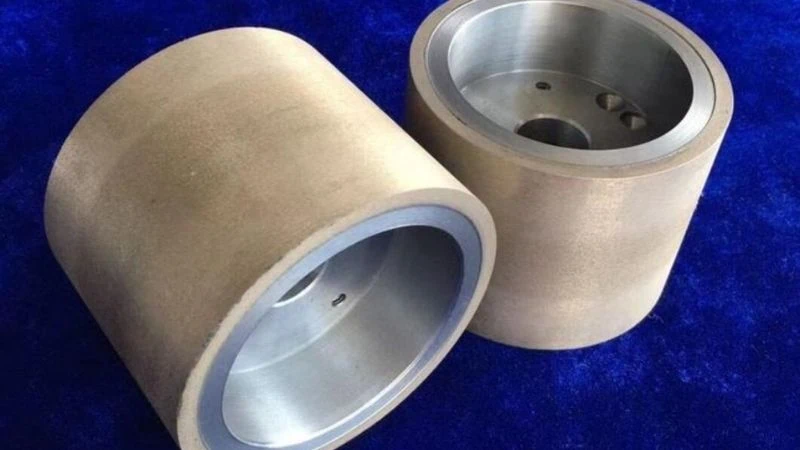
The wheel core provides the structural rigidity necessary to absorb machine vibrations, while the outer abrasive layer dictates the actual cutting action and longevity. By carefully engineering both elements, manufacturers ensure consistent dimensional accuracy, maximize wheel lifespan, and significantly lower the overall cost per part.
Selecting Core Materials to Dampen Vibration on Wide Wheels
Centerless grinding wheels are typically very wide. They often range from 4 to 20 inches across the cutting face. Consequently, this massive physical width acts as an amplifier for machine vibration.
Have you ever experienced unexplained chatter marks6 on your finished parts? This defect often stems from poor core material selection. Just as a heavy boring bar chatters in a deep lathe operation without a tuned mass damper, a wide grinding wheel vibrates without proper core support. You specifically need a material that effectively absorbs these machining harmonics.
Manufacturers construct wheel cores from several distinct materials to combat this issue. Each material provides a unique balance of weight and dampening capability.
Common Wheel Core Materials for Centerless Applications
| Core Material | Vibration Dampening | Structural Rigidity | Best Application Scenario |
|---|---|---|---|
| Aluminum | Low | Moderate | Standard setups requiring lighter spindle loads. |
| Steel | Very Low | Extremely High | Narrower wheels requiring maximum form holding. |
| Bakelite (Resin) | High | Moderate | Wide wheels prone to chatter and harmonics. |
| Carbon Fiber | Extremely High | High | High-speed operations requiring minimum weight. |
Aluminum cores remain the industry standard for general use. They actively reduce the physical load on the machine spindle. However, for extremely wide thru-feed applications, Bakelite or composite cores perform better. They naturally absorb the continuous vibrations generated during high-volume production.
Optimizing Abrasive Depth for Long-Run Cost Efficiency
The abrasive layer contains your highly expensive Diamond or CBN particles. Should you purchase a wheel with a 3mm or a 10mm abrasive depth? This decision directly impacts your long-term profitability.
A thicker abrasive layer requires a higher initial financial investment. However, it drastically reduces your long-term operational costs. In high-volume centerless grinding, machine downtime is your biggest hidden expense. Every single time you swap a depleted grinding wheel, you lose valuable production hours.
By choosing a thicker abrasive layer, you maximize machine uptime. For example, upgrading from a 3mm to a 6mm depth typically doubles the total wheel life. Yet, it rarely doubles the initial purchase price. Therefore, a thicker layer provides a highly measurable return on investment.
A shop processing 4140 steel pins can often run uninterrupted for months with a deeper abrasive layer. This consistency directly lowers the overall cost per part. Note that the maximum allowable abrasive depth depends heavily on the specific bonding process used and the structural integrity of the wheel design.
Determining Grit Size and Concentration for Target Finishes
The abrasive layer specifications dictate how the wheel physically cuts. You must carefully balance both grit size and abrasive concentration7.
Grit size directly controls your final surface finish and material removal rate. Larger, coarse abrasive grains remove material rapidly. Therefore, they are perfectly suited for heavy roughing passes. Conversely, fine grits produce a smooth, mirror-like surface.
Concentration refers to the sheer volume of Diamond or CBN particles suspended within the bond. For instance, a 100 concentration means the abrasive layer contains exactly 25% superabrasive material by volume.
What happens if your abrasive concentration is too low? The wheel will wear prematurely. The sparse remaining grains take on too much cutting force and eventually fracture. On the other hand, if the concentration is too high, the wheel acts extremely hard. It may glaze over rapidly and thermally damage the workpiece.
- Low Concentration (50 – 75): Ideal for wide contact areas to ensure a free-cutting action.
- High Concentration (100 – 125): Ideal for strict form holding and maintaining sharp corners.
For instance, grinding hardened aerospace fasteners might require a fine 400-grit wheel. You might specifically pair this fine grit with a lower 75 concentration. This specific combination successfully balances a superior surface finish with a consistent, free-cutting action.

Achieving System Synergy with Machine Components
What happens when a high-performance superabrasive wheel is paired with the wrong machine components?
Without perfect system synergy, even the best Diamond or CBN wheel will fail. Achieving synergy requires matching your grinding wheel with a regulating wheel that provides enough frictional grip to control part rotation, and a work rest blade engineered to prevent material galling and ensure smooth feeding.
Pairing Your Superabrasive with the Correct Regulating Wheel
The regulating wheel, often called the feed wheel, acts as the braking system for your centerless operation. It strictly controls how fast the workpiece spins. Because Diamond and CBN wheels remove material very efficiently, they naturally generate strong rotational forces against the part.
Consequently, your regulating wheel must maintain a flawless grip. What happens if this grip fails? The workpiece will suddenly spin at the same high speed as the grinding wheel. This dangerous situation immediately ruins the part and can severely damage the machine.
To prevent slippage, you must match the regulating wheel material to your specific grinding pressure. Standard rubber bonds work well for conventional abrasives. However, aggressive superabrasive applications often require specialized polyurethane or rubber-cork blends. These distinct formulations offer a significantly higher coefficient of friction.
Think of a lathe chuck gripping a heavy steel shaft while a large carbide turning tool engages. If the chuck jaws lack friction, the shaft slips. The regulating wheel performs the exact same gripping function. It simply uses friction instead of mechanical jaws.
Regulating wheels typically feature a hardness rating between 80 and 95 Shore A durometer8. A harder wheel holds its dressed shape longer, while a softer wheel provides superior grip. Keep in mind that the optimum durometer rating will vary based on your specific part weight and coolant type. Therefore, you should always verify the exact hardness specifications with your supplier to match your unique production environment.
Selecting Work Rest Blade Materials to Prevent Galling
The work rest blade physically supports the workpiece between the two wheels. As the part rotates rapidly, it constantly rubs against this supporting blade. This continuous friction creates a major manufacturing risk known as galling9.
Galling occurs when extreme pressure and friction cause microscopic pieces of the workpiece to weld onto the blade. Once this material buildup starts, it acts like a jagged cutting tool. It will violently scratch the surface of every subsequent part that passes through the machine.
Because CBN and Diamond wheels often run at higher speeds and pressures, selecting the correct blade material is absolutely critical. You must choose a blade surface that resists this cold-welding effect.
Recommended Work Rest Blade Materials
| Blade Material | Workpiece Compatibility | Primary Benefit |
|---|---|---|
| Carbide Tipped | Hardened Steel, Cast Iron | Extreme wear resistance for high-volume CBN grinding. |
| Bronze / Brass | Soft Steels, Aluminum | Excellent lubricity to prevent scratching on soft parts. |
| Cast Iron | Stainless Steel, Titanium | Naturally prevents galling on highly reactive alloys. |
| PCD (Diamond) | Solid Carbide, Ceramics | Maximum lifespan when paired with Diamond grinding wheels. |
Selecting the wrong blade is similar to using the wrong cutting insert grade in a milling operation. If the insert grade sticks to the metal, you get a built-up edge (BUE) that ruins the cut. Using a carbide blade on a soft stainless steel part will cause a similar, disastrous buildup.
Furthermore, the top angle of the blade heavily influences part stability. Standard blade angles usually range from 20 to 30 degrees. However, this optimal angle changes depending on your specific workpiece diameter and center height. Precise geometric details must be engineered for your specific setup to ensure proper feeding mechanics.

Effective On-Machine Truing and Dressing Solutions
What are the most reliable methods for conditioning superabrasive wheels without removing them from the centerless grinder?
Effective on-machine conditioning requires perfectly matching your specific truing device to the abrasive wheel’s bond type. You must use rigid rotary plunge dressers to physically fracture hard vitrified bonds, while utilizing brake-controlled truing devices to safely shear the softer matrix of resin bonds without inducing thermal damage.
Utilizing Rotary Plunge Dressers for Vitrified Wheels
Vitrified CBN wheels possess a very rigid, glass-like ceramic structure. Consequently, traditional single-point diamond tools often struggle to condition them. The extreme hardness of the CBN simply destroys the single-point tool. Therefore, you must use a rotary plunge dresser.
A rotary plunge dresser is a motorized spindle that holds a diamond-plated roller. This tool plunges directly into the face of the grinding wheel. The motor drives the diamond roller at a specific RPM. As a result, it creates a crushing and shearing action against the vitrified bond.
Consider a heavy-duty gear hobbing10 machine. The rigid cutter rotates continuously to forcefully carve a profile into a solid steel blank. A rotary plunge dresser operates on this exact same principle. It relies on continuous, powered rotation to aggressively force a fresh profile into the hard grinding wheel.
This powered rotation is absolutely critical for vitrified wheels. It successfully shatters the dull CBN grains and opens the ceramic pores. Consequently, the wheel regains its free-cutting ability.
However, you must strictly control the speed ratio between the dresser and the grinding wheel. Typically, the dresser runs at a speed ratio of 0.8 to 0.9 relative to the grinding wheel speed. A unidirectional rotation creates a rougher, aggressive wheel surface. Conversely, a bidirectional rotation generates a smoother finish. Optimal speed ratios and plunge feed rates depend heavily on the specific diamond roller design and your machine’s overall rigidity.
Applying Brake Controlled Truing Devices for Resin Bonds
Resin bond Diamond wheels require a completely different approach. Because the resin matrix is relatively soft and flexible, a powered rotary dresser would simply melt the bond. The high friction would generate excessive heat. Therefore, a brake-controlled truing device provides the perfect solution.
A brake truing device does not have an internal drive motor. Instead, it freely holds a standard silicon carbide or aluminum oxide truing wheel. When you push this device against the spinning Diamond wheel, the truing wheel begins to spin along with it.
Here is the clever part. The device features an internal mechanical or magnetic brake. This brake purposely slows down the truing wheel. Consequently, it creates a controlled speed differential between the two rotating wheels.
Think of a mechanical clutch plate slipping against a spinning flywheel. The engineered friction between the two surfaces gently wears away the softer material. The brake truer uses this exact frictional slipping action. It gently scrubs away the soft resin bond without generating dangerous levels of heat.
As the resin wears away, the dull diamond grains fall out. Fresh, sharp diamonds are immediately exposed. This process is highly effective for preparing precision plunge grinding wheels.
Comparison of Truing Methods
| Conditioning Method | Wheel Bond Type | Drive Mechanism | Primary Action |
|---|---|---|---|
| Rotary Plunge Dresser | Vitrified CBN | Powered Motor | Crushing and Shearing |
| Brake Controlled Device | Resin Diamond | Mechanical Brake | Frictional Scrubbing |
For maximum effectiveness, the truing wheel’s grit size must match your Diamond wheel. Generally, you should select a silicon carbide truing wheel that is one grit size coarser than your superabrasive wheel. Keep in mind that exact brake tension settings and truing wheel specifications depend heavily on your specific resin formulation. Therefore, you must seamlessly verify the recommended brake resistance and grit pairings with your supplier before beginning the procedure.
Conclusion
Choosing the right superabrasive wheel for centerless grinding is a strategic process that directly dictates your production efficiency and part quality. By understanding the distinct mechanics of your feed system and selecting the corresponding bond types, core materials, and on-machine conditioning tools, you can eliminate costly downtime and achieve optimal dimensional accuracy. A well-engineered wheel setup transforms a demanding grinding operation into a seamless, high-volume production cycle. If you require further assistance optimizing your grinding parameters or selecting the exact specifications for your next project, please feel free to contact us.
References
- Thermal expansion1 – Wikipedia article detailing the physical property of thermal expansion and how it affects materials under heat.
- Vitrified CBN wheels2 – ZYDiamondTools product category page featuring vitrified bond diamond and CBN grinding wheels.
- Cubic Boron Nitride3 – Wikipedia page outlining the material properties, structure, and industrial uses of Boron Nitride.
- Resin bond diamond wheel4 – ZYDiamondTools product category page featuring resin bond diamond and CBN grinding wheels.
- Metal bond wheels5 – ZYDiamondTools product category page featuring metal bond diamond and CBN grinding wheels.
- Chatter marks6 – Wikipedia entry on machining vibrations, explaining their causes and effects on part surface finish.
- Abrasive concentration7 – ZYDiamondTools guide on how to choose the right diamond concentration for optimal grinding efficiency.
- Shore A durometer8 – Wikipedia article defining the Shore durometer scale used to accurately measure the hardness of polymers and rubbers.
- Galling9 – Wikipedia page explaining the phenomenon of galling, a form of severe adhesive wear common in metal-on-metal friction.
- Gear hobbing10 – Wikipedia article providing an overview of hobbing, a robust machining process used for cutting gears and splines.